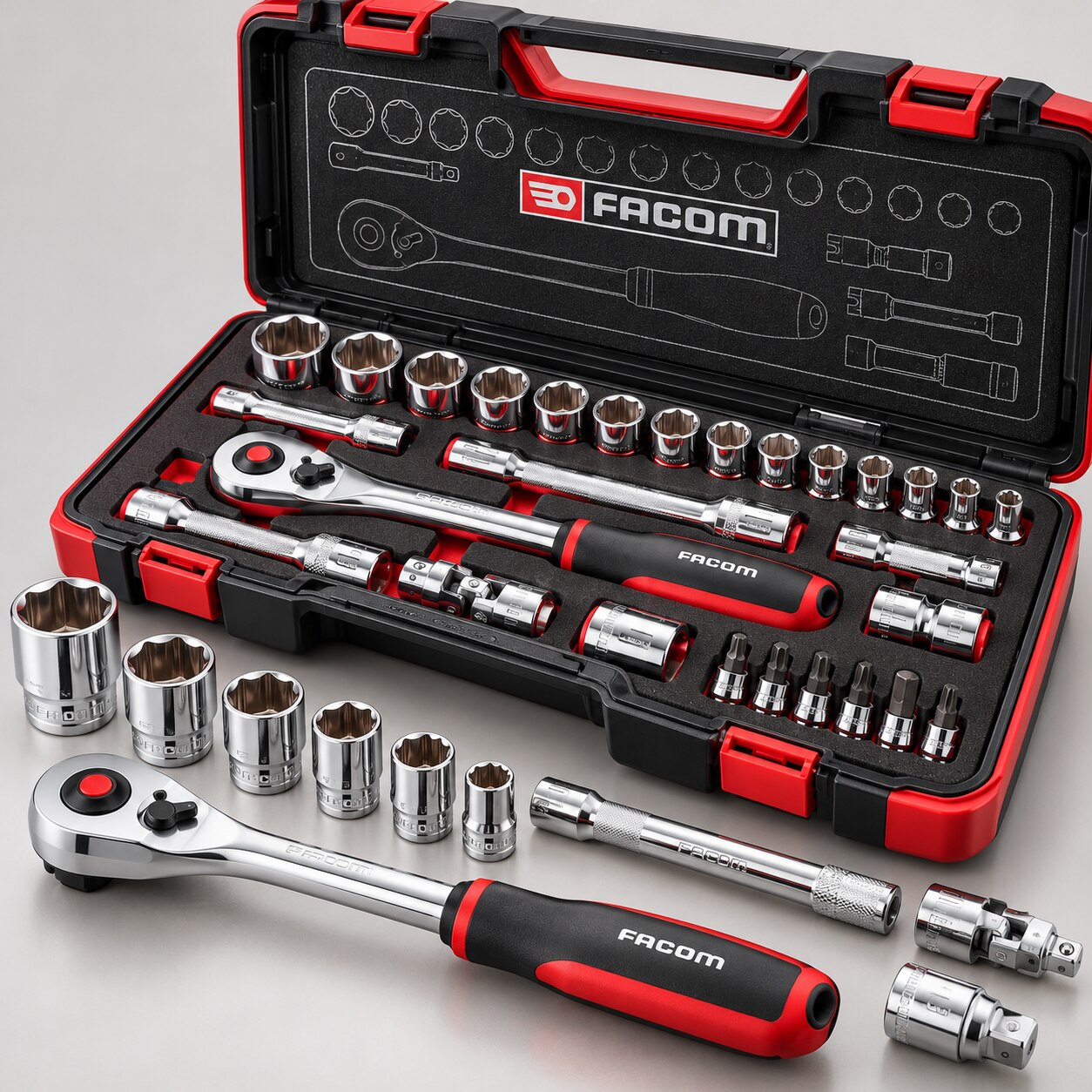
A ratchet set’s piece count tells you little about how well it will work beside an engine, under a vehicle, or on a high-torque fastener. By comparing drive size, mechanism, access features, socket types, safety limits, and service support, you can select a FACOM set that matches the work rather than paying for unused pieces.
Key takeaways
- Treat tooth count as access information, not proof of torque capacity.
- Match drive size and socket type to fastener size and working load.
- Use extensions and retention features only when they preserve control and engagement.
- Choose impact sockets for powered tools; use chrome hand sockets with ratchets.
Which Ratchet Mechanism Features Matter in Workshop Use?
A 72-tooth ratchet gives about a 5-degree swing arc, so you can reset the handle where an engine bracket or chassis member allows little movement. Tooth count alone does not prove permissible torque or service life. Compare the complete FACOM ratchet features, not just the number printed in the catalogue.
| Feature | Workshop effect | What to inspect |
|---|---|---|
| Tooth count and swing | More teeth shorten the handle movement needed to engage the next position. | Confirm the stated tooth count and return angle; do not treat either as a torque rating. |
| Ratchet-head profile | A thin, narrow head reaches between brackets, but reduced internal space can limit pawl and switch robustness. | Compare head thickness and width, not only the ratchet-head profile. |
| Reversing control | A protected lever changes direction without removing the socket. | Reject a lever that protrudes far enough to catch on nearby parts and reverse under load. |
| Handle dimensions | A longer handle improves leverage but needs more clearance and increases accidental over-torque risk. | Match length to access and fastener load; use a larger drive for demanding work instead of forcing a small ratchet. |
| Grip | A shaped, slip-resistant grip improves control with oily or gloved hands. | Check grip diameter, texture and end shape for sustained use. |
A sealed head limits direct entry of dirt and fluid, but it is not maintenance-free. Check the full product code because R, J and S families commonly identify 1/4-inch, 3/8-inch and 1/2-inch drives, while length, flex and locking options can differ.
How Should You Match Drive Size and Socket Type to the Job?
Use a 1/4-inch drive for light fasteners, trim, clamps and confined engine-bay access. Choose a 3/8-inch drive as the general-purpose automotive option. A 1/2-inch drive suits high-torque chassis, suspension, wheel and larger mechanical fasteners, but its heavier head and sockets reduce access in tight spaces.
| Drive size | Best use | Trade-off |
|---|---|---|
| 1/4-inch drive | Small fasteners and restricted access | Lower torque capacity |
| 3/8-inch drive | General automotive and workshop work | Less access than 1/4-inch |
| 1/2-inch drive | Suspension, wheels and high-torque joints | Greater size and weight |
6-point sockets versus 12-point sockets involves grip versus access. Six-point sockets spread load across the fastener’s flats, making them safer for high torque or partly rounded heads. Twelve-point sockets offer twice as many engagement positions, helping when the ratchet can move only a small distance, but they are easier to damage under excessive torque.
Check the contents list rather than trusting the piece count:
- Confirm metric coverage and identify whether imperial sizes are included or absent.
- Look for both shallow and deep sockets; deep versions clear protruding studs and recessed nuts.
- Check for external Torx, internal Torx, hex bits and spark-plug sockets.
- Verify extensions, a universal joint, adapters and the ratchet handle.
- Treat pneumatic and battery-impact work separately: use sockets explicitly marked for impact use, not ordinary chrome hand sockets.
- Verify the complete product code; FACOM R, J and S prefixes commonly indicate 1/4-inch, 3/8-inch and 1/2-inch families, but head and handle specifications can differ.
How Do Access, Retention, and Extensions Change Ratchet Use?
Use a low-profile ratchet head beside engine components, brackets, and bodywork, but compare head thickness and width rather than tooth count alone. A thinner head can leave less room for its pawl and switching mechanism, affecting durability and control.
| Head or accessory | Access benefit | Control or load limitation |
|---|---|---|
| Fixed head | Keeps the handle aligned | Best for high torque and straight-line work |
| Flex-head ratchet | Reaches around pipes, subframes, and bodywork | The pivot adds a wear point and can move unexpectedly under load |
| Wobble extension | Adds slight angular reach | Reduces socket control; use for access and run-down |
| Universal joint | Reaches offset fasteners | Increases angular loading; finish tightening or loosening straight-on |
A flex-head ratchet solves an access problem, not every torque problem. Lock the pivot if the design provides that function, and use a fixed head when the handle must stay positively aligned.
Socket retention determines whether a fastener remains attached during awkward work. A spring-loaded ball suits ordinary use; push-button release speeds frequent socket changes, while a locking square is safer for overhead, vertical, or pull-through work.
Keep extensions as short as access permits. Long extensions amplify movement and make it harder to keep the socket square. A universal joint belongs near the socket only when necessary, not as a substitute for alignment during final torque.
Check the complete product code before ordering: FACOM R, J, and S families commonly indicate 1/4-inch, 3/8-inch, and 1/2-inch drives, but head style, length, flex, and locking details vary. A reversing lever recessed within the head also avoids accidental direction changes in confined spaces.
When Are Chrome Hand Sockets and Impact Sockets Suitable?
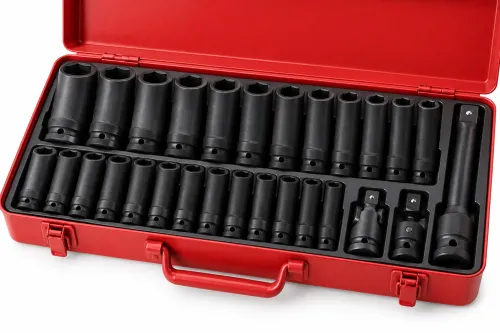
Drive size alone does not identify a socket’s safe use. Chrome hand sockets have a polished chrome finish and are intended for manual ratchets; impact sockets have thicker walls, impact-rated steel, and commonly a black oxide finish. Look for “impact” or “impact-rated” marking, not colour alone.
- Choose chrome hand sockets for turning fasteners with a hand ratchet or breaker bar. Do not put them on a pneumatic or battery impact tool: shock loading can crack the socket.
- Choose impact sockets for powered impact tools. Secure through-hole sockets with a retaining pin and securing ring when the tool and socket provide matching holes; never rely on a loose improvised pin.
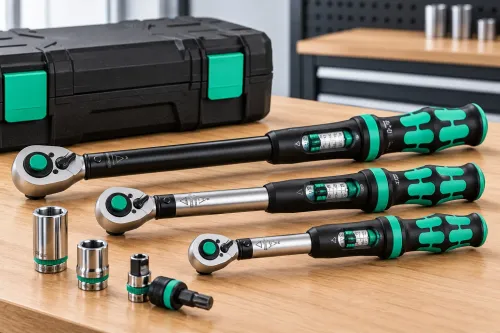
Use the ratchet as a running and tightening tool, not as a substitute for leverage or torque measurement.
- Break a seized fastener loose with a breaker bar, then switch to the ratchet. High initial force can strip fine teeth or damage the pawl.
- Keep the socket fully seated and pull the handle smoothly. Do not hammer the handle or add a pipe extension.
- Operate the reversing lever only when the drive is unloaded. A protruding lever can catch against engine components and reverse the tool under load.
- Stop tightening with the ratchet when a torque specification applies. Perform the final pass with a calibrated torque wrench; extensions and universal joints can change access and applied torque.
- Clean contamination from the head and follow the manufacturer’s lubrication procedure. A sealed head limits dirt entry but is not maintenance-free.
What Should a Workshop Verify Before Buying a FACOM Ratchet Set?
A purchase order should name the exact FACOM product code, not simply “FACOM ratchet set.” Confirm the complete code because R, J and S families cover different drive sizes, while head profile, handle length, flex or locking function can vary within a family.
| Drive | Verify | Workshop trade-off |
|---|---|---|
| 1/4 in | Ratchet, sockets and extensions match the code | Best access; limited capacity for heavy fasteners |
| 3/8 in | General-purpose automotive coverage is complete | Useful balance of reach, strength and weight |
| 1/2 in | High-load sockets and a suitable handle are included | More torque; greater bulk in confined areas |
Read the contents list rather than trusting the piece count. Confirm metric and imperial socket coverage, deep sockets, 6-point and 12-point formats, external and internal Torx, hex bits, spark-plug sockets, extensions and universal joints.
Check whether the set includes a ratchet handle at all, and reject duplicate shallow sockets if the missing deep sizes affect your jobs.
Before ordering, ask for these confirmations:
- Repair kit availability for the exact ratchet code, including the pawl, spring, selector and retaining parts.
- The manufacturer’s cleaning and lubrication procedure, even for a sealed-head ratchet.
- Replacement socket, extension and universal-joint ordering routes.
- Warranty terms, service contact, and expected parts lead time.
Miracle Tools And Tackle LLP can help a buyer compare a listed FACOM code with the supplied contents, but obtain that match in writing before approving the order. Also check that the reversing lever sits within the head profile; a protruding lever can be knocked and reverse the drive under load.
Related products
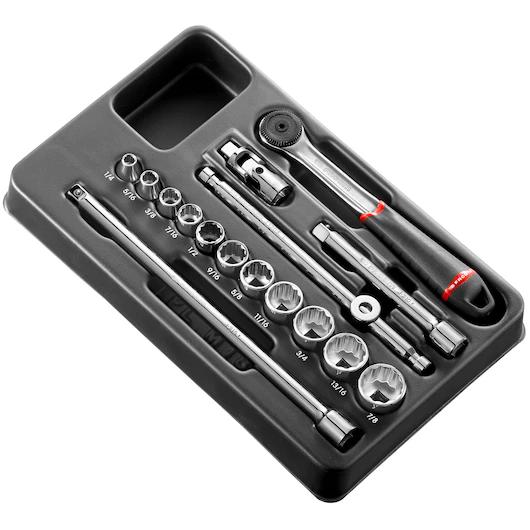 | Socket Set FACOM MOD.J161-212U Socket Set FACOM MOD.J161-212U 1/2 in. Drive Socket Set – Professional Socket Tool Set The FACOM MOD.J161-212U 1/2 in. View product → |
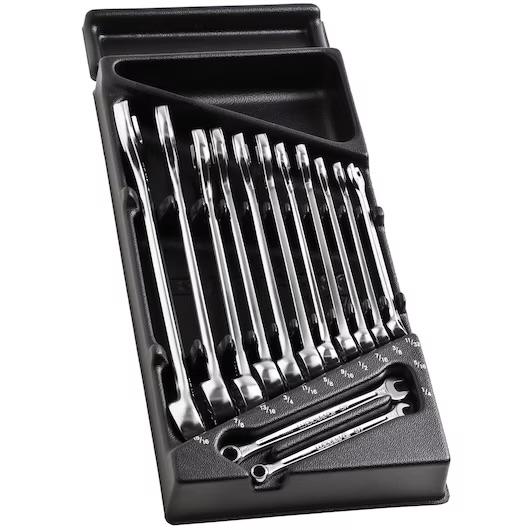 | COMBINATION WRENCHES FACOM MOD.440-4PB COMBINATION WRENCHES Professional Hand Tool Set The FACOM MOD.440-4PB Combination Wrenches are professional-quality hand tools designed for reliable fastening and... View product → |
Frequently asked questions
Which ratchet mechanism features matter in workshop use?
Compare tooth count, swing arc, permissible torque, reversing control, mechanism durability and the ratchet head’s access clearance. A 72-tooth mechanism gives about a 5-degree reset arc, but tooth count alone does not establish strength or service life.
How should you match drive size and socket type to the job?
Match the drive size to the required socket range and available clearance, then choose a socket profile that fits the fastener. Use chrome hand sockets with manual ratchets and impact sockets with powered impact tools.
How do access, retention and extensions change ratchet use?
A slim head and small swing arc help in confined spaces. Ball detents or locking retention help keep sockets attached, while extensions add reach but can reduce feel and increase misalignment risk.
When are chrome hand sockets and impact sockets suitable?
Use chrome hand sockets for manual ratchet work. Use impact sockets, identified by their impact-rated construction and dark finish, with pneumatic or electric impact tools; do not substitute ordinary chrome sockets.
What should a workshop verify before buying a FACOM ratchet set?
Check the drive sizes, socket range, metric or imperial markings, ratchet tooth count, torque information, head profile, retention system, extension contents, warranty terms and whether the set includes impact-rated sockets.